
(Leeds-Grenville ON – June 8, 2023)

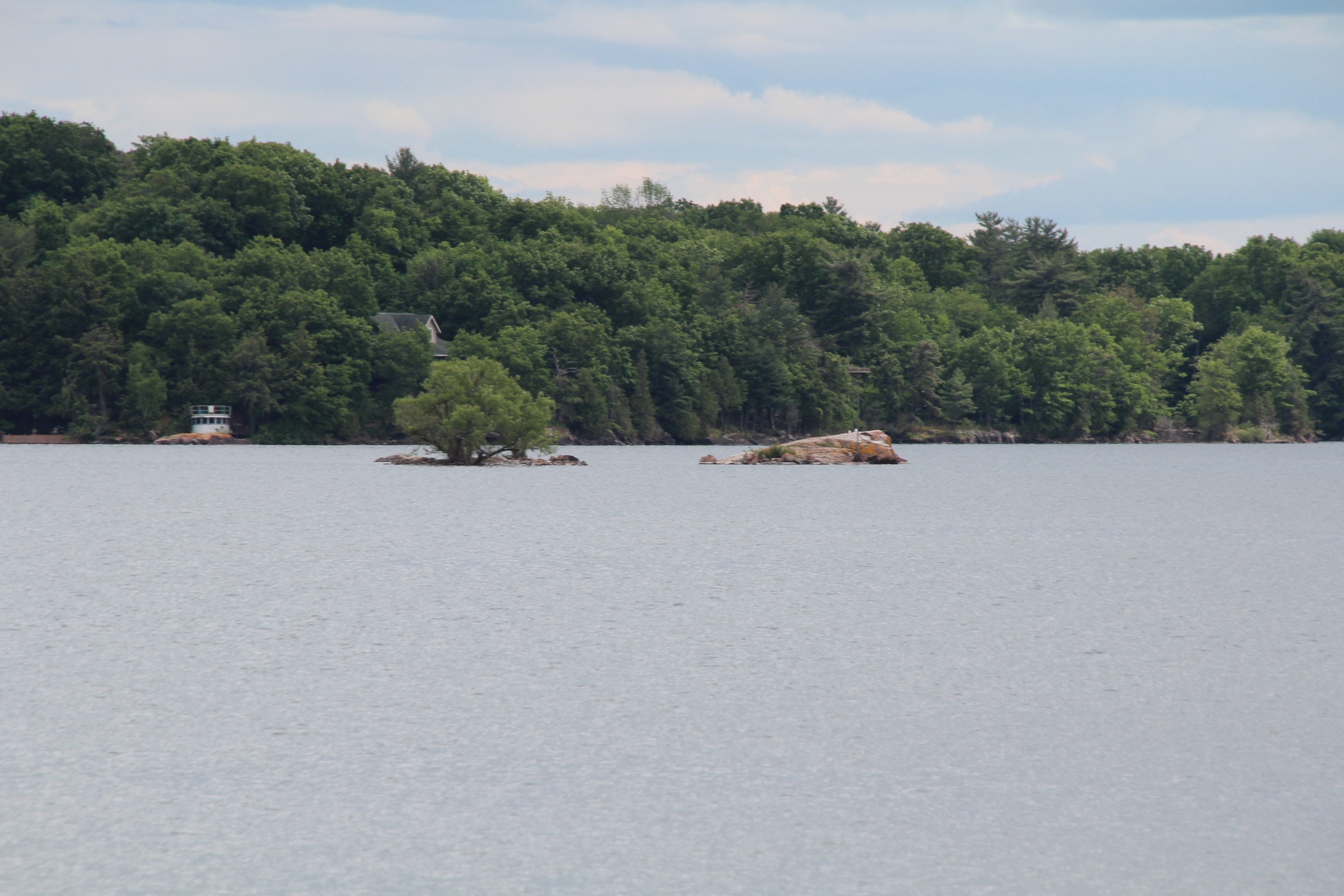
The difference a day makes. These photos were taken about 24-hours apart at the Halstead Bay Lookout on the Thousand Islands Parkway. The smoke was at about AQHI 7-10 in one, and AQHI 1-3 in the other. Depending on various factors, it does not take long for conditions to change. Lorraine Payette
Just when we think it’s over, back it comes – smoke from the various fires burning across Ontario, Quebec and Nova Scotia. While the latest rains have cleaned the air for awhile, it will take some time before it can be considered clear again.
“Environment Canada has issued a Special Air Quality Statement for much of Eastern Ontario including the Counties of Leeds, Grenville and Lanark,” said Susan Healey, Communications Co-ordinator for the Leeds, Grenville and Lanark District Health Unit (LGLDHU). “Elevated levels of air pollution are present due to smoke from forest fires burning in Ontario and Quebec. Poor outdoor air quality (may) continue for several days.”
To help keep the public informed, an Air Quality Health Index is available at www.airqualityontario.com/aqhi/index.php which lists numerous locations as well as levels of risk. Select the municipality nearest to you to get a reasonable idea of the risk in your area. There are categories, values and associated colours to help you understand how things are in your location.
“There are no air quality monitoring stations in LGL (Leeds-Grenville-Lanark),” she said. “The province maintains 39 air monitoring stations across Ontario. Cornwall, Ottawa and Kingston are the closest monitoring stations to LGL and will provide the most accurate data for us.
“During air pollution events, the air quality can change quickly so check the province’s Air Quality Health Index (AQHI) website regularly. To help guide your actions, use the Health Unit’s Air Quality webpage and the information below to see what the health messages are for the general population and people who are considered at greater risk for negative health consequences. The Health Unit will provide regular updates on the local outdoor air quality situation on our Facebook and Twitter pages. Information is also available on the Health Unit’s Air Quality webpage.”
The Health Unit has provided the following list of risk levels and how to deal with them.
Low Health Risk (AQHI 1-3)
· Health Risk for At Risk Population (People with heart or breathing problems are at greater risk. Follow your doctor’s usual advice about exercising and managing your condition.): Enjoy your usual outdoor activities.
· Health Risk for General Population: Ideal air quality for outdoor activities.
· Specific Groups:
o Youth outdoor physical activity/sports: no recommendations
o Adult outdoor physical activity/sports: no recommendations
o Outdoor work: no recommendations
Moderate Health Risk (AQHI 4-6)
· Health Risk for At Risk Population (People with heart or breathing problems are at greater risk. Follow your doctor’s usual advice about exercising and managing your condition.): Consider reducing or rescheduling strenuous activities outdoors if you are experiencing symptoms.
· Health Risk for General Population: No need to modify your usual outdoor activities unless you experience symptoms such as coughing and throat irritation.
· Specific Groups:
o Youth outdoor physical activity/sports: can continue for individuals not experiencing symptoms
o Adult outdoor physical activity/sports: can continue for individuals not experiencing symptoms
o Outdoor work: can continue for individuals not experiencing symptoms
High Health Risk (AQHI 7-10)
· Health Risk for At Risk Population (People with heart or breathing problems are at greater risk. Follow your doctor’s usual advice about exercising and managing your condition.): Reduce or reschedule strenuous activities outdoors. Children and the elderly should also take it easy.
· Health Risk for General Population: Consider reducing or rescheduling strenuous activities outdoors if you experience symptoms such as coughing and throat irritation.
· Specific Groups:
o Youth outdoor physical activity/sports: avoid or reduce
o Adult outdoor physical activity/sports: can continue for individuals not experiencing symptoms
o Outdoor work: can continue for individuals not experiencing symptoms
Very High Health Risk (AQHI above 10)
· Health Risk for At Risk Population (People with heart or breathing problems are at greater risk. Follow your doctor’s usual advice about exercising and managing your condition.): Avoid strenuous activities outdoors. Children and the elderly should also avoid outdoor physical exertion.
· Health Risk for General Population: Reduce or reschedule strenuous activities outdoors, especially if you experience symptoms such as coughing and throat irritation.
· Specific Groups:
o Youth outdoor physical activity/sports: avoid
o Adult outdoor physical activity/sports: avoid or reduce
o Outdoor work: avoid or reduce
Source: Government of Canada: Understanding Air Quality Health Index messages
They also advise going to www.ontario.ca/page/forest-fires for information about current forest fire danger and forest fire activity. The site includes an interactive map and fire restrictions across the province.
“Forest fire smoke can be harmful to everyone’s health, even at low concentrations,” said Healey. “People with lung disease such as asthma, chronic obstructive pulmonary disease, or heart disease, older adults, pregnant people, infants and young children, and people who work or exercise outdoors are at higher risk of experiencing negative health effects caused by forest fire smoke.”
The Health Unit advises avoiding smoke from the forest fires by doing the following:
- Limit outdoor activities. If you have difficulty breathing, reduce your activities or stop altogether. Consider wearing a respiratory mask (N95, KN95) when outdoors.
- Stay cool and drink lots of water to help your body cope with the smoke.
- Check in on others who may be more vulnerable to air pollution.
- Prevent outdoor air from getting into your home by:
- Keeping windows and doors sealed.
- Installing a high quality air filter in your heating, ventilation and air conditioning (HVAC) system to remove air pollution from incoming air. Set the HVAC system to recirculation mode.
- Limit the use of exhaust fans when not cooking.
- Avoid sources of indoor air pollution:
- Smoking
- Burning incense and candles
- Vacuuming
- Using wood stoves
- Using cleaning products that emit volatile organic compounds (VOCs)
- For those with lung or heart disease, ensure that you have the medication you need to manage symptoms and prevent exacerbations.
For more information, see these websites:
- www.canada.ca/en/environment-climate-change/services/air-quality-health-index/wildfire-smoke/wildfire-smoke-health.html – protecting health from wildfire smoke
- weather.gc.ca/?zoom=3¢er=44.67885668,-79.50786318 – national weather alerts
- www.airqualityontario.com/alerts/signup.php – email notifications on air quality
- healthunit.org/health-information/home-health-safety/air-quality/ – LGLDHU Air Quality
(Lists provided by LGLDHU.)
 A Fresh News Start